measurement of utility
Can Utility be Measured?
Utility is a psychological concept. This is different for different people. Therefore, it cannot be measured directly. Professor Marshall has said that “Utility can be measured and its measuring rod is ‘money. The price which we are ready to pay for an article is practically its price. Nobody will be prepared to pay more than the utility which we derive from the article.
For example:
If I am ready to pay Rs. 1500 for a watch and Rs. 2,000 for a Radio. Then I can say that I derive utility from that watch up to the value of Rs. 1500; and from Radio up to the value of Rs. 2,000. “The inference which we can draw from the above example is that the price which we pay for any article is the utility which we derive from that article.” But Prof. Hicks, Allen and Pareto have not supported Marshall’s view of measuring utility.
Measurement of Utility
Measurement of a utility helps in analyzing the demand behavior of a customer. It is measured in two ways
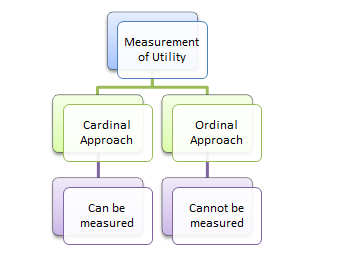 CARDINAL UTILITY MEASUREMENT:-The Cardinal Utility approach is propounded by neo-classical economists, who believe that utility is measurable, and the customer can express his satisfaction in cardinal or quantitative numbers, such as 1,2,3, and so on.Util is a hypothetical unit of measurement of utility that is commonly used by economists to present hypothetical information about utility and consumer demand theory.For example:-If a Nissan car gives 5,000 utils of utility, a BMW car would give 8,000 units.Similarly, an apple can give 20 utils of utility whereas a mango can give 50 utils of utility.
Laws under cardinal utility theory- Law of Diminishing Marginal Utility ; Law of Equi Marginal Utility
For example, he prefers a BMW car to a Nissan car, but don’t say by how much.He prefer an apple over a mango and so on.It is argued this is more relevant in the real world. When deciding where to go for lunch, we may just decide I prefer an Italian restaurant to Chinese. He doesn’t calculate the exact levels of utility.
Modern economists, particularly Hicks gave ordinal utility concept to analyze consumer behavior.He has used a tool, called indifference curve, for consumer behavior analysis.
Comments
Post a Comment